State Police Crime Lab fingerprint report
Defending JacobThe State Police Crime Lab fingerprint report is the forensic document that matched Jacob Barber’s right thumbprint to a print on Ben Rifkin’s sweatshirt. Its specific comparison gave investigators a concrete connection between Jacob and the victim, while the report itself did not establish why Jacob had touched the sweatshirt or prove that he had committed the murder.
Discovery and Disclosure
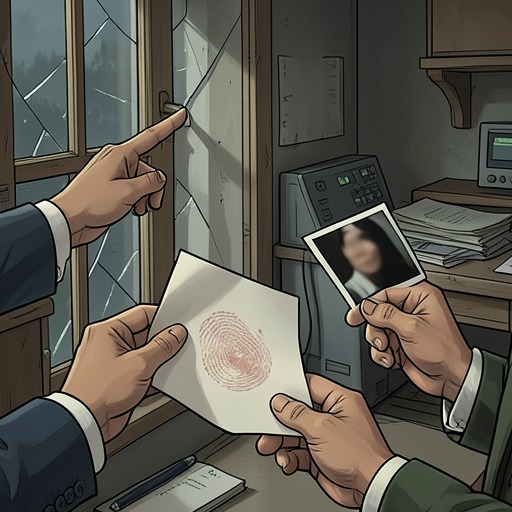
The report reaches Andrew Barber through Lynn Canavan, who presents the news as they discuss the Rifkin case. She slides the stapled document toward him and tells him that the print on the victim’s sweatshirt belongs to his son, Jacob. The scene turns the investigation’s evidence into a personal crisis: Andrew is not only Jacob’s father but a prosecutor accustomed to assessing forensic claims.
Andrew scans the report and immediately looks for an explanation. His response registers bewilderment rather than acceptance, and Canavan answers that she is sure there is one. The exchange captures the report’s disruptive force without resolving what the print means.
The Fingerprint Comparison
Produced by the State Police Crime Lab, the report identifies twelve points of comparison between a latent print recovered from the murder scene and one of the known prints on Jacob’s print card. The account notes that this exceeds the eight points ordinarily required for a positive match. The identified print is Jacob’s right thumb.
The report places the print on the inside tag of Ben’s unzipped sweatshirt. Andrew’s understanding is that Jacob reached out and grabbed Ben by the sweatshirt, leaving the impression there. That conclusion specifies how the print may have been deposited, but it is not an account of the surrounding encounter: the forensic match locates Jacob’s thumb on the garment, not the reason for the contact or the events that led to it.
Evidentiary and Narrative Significance
The report changes the case from a dispute about suspicion into a confrontation with a specific physical trace. Its numerical comparison gives the finding procedural authority, yet the document’s narrow conclusion leaves room between identification and interpretation. The match establishes whose print was present; it does not, by itself, settle whether the contact was innocent or criminal.
The report’s significance also depends on its presentation. Readers encounter it through Andrew’s recollection of Canavan’s disclosure, then later through the trial’s documentary procedure, when Neal Logiudice asks Andrew to recognize a document marked as an exhibit. The report thus appears both as a private shock and as a formal item in court. Across those settings, its central fact remains stable, while its meaning is argued over within a case whose public and personal consequences extend far beyond the laboratory comparison.